Your constantly-updated definition of Creative Thinking in UX/UI Design and
collection of videos and articles. Be a conversation starter: Share this page and inspire others!
192shares
What is Creative Thinking in UX/UI Design?
Creative thinking in UX (user experience) / UI (user interface) design is the process of using divergent, imaginative approaches to conceive user experiences and interfaces that go beyond any formula. You apply it to explore unconventional ideas, generate novel interactions, and push boundaries, while grounding designs in real user needs so that what you ideate and release into the marketplace resonates as novel, usable, and delightful.
In this video, Alan Dix, Author of the bestselling book Human-Computer Interaction and Director of the Computational Foundry at Swansea University, explains how true creative thinking in UX and UI design comes from working deliberately with ideas (experimenting, combining, and refining them) illustrated through real examples that show creativity as a practiced process rather than a moment of genius.
ShowHide
video transcript
Transcript loading…
Creative Thinking: Your Passport to Design Dreams
Creative thinking may seem almost too nebulous to try to “contain” as a subject of study. However, like an ocean, deep, wide, long, and unfathomably rich, it offers almost countless directions for you to sail and discover amazing places you might not dream of otherwise. And when you tap those “currents” while thinking creatively, you can propel yourself much further than just imagining nice-to-have aesthetic flourishes. Benefits of creative thinkinginclude how it changes what problems you see and how you solve them, namely in how it:
Leads to Richer, More Differentiated Experiences
If you only follow known patterns and stay “safe,” your interfaces risk blending into the crowd. Creative thinking helps you surprise and delight users with interactions they didn’t expect but intuitively understand.
Helps You Locate Deeper User Needs
By reframing a user problem, you might discover that users aren’t asking for a “search filter,” for example, but for a way to browse that’s unexpectedly fresh and fun. Creative thinking surfaces latent needs that strict, task-focused thinking misses. When you achieve such unique angles on user needs and problems, it’s like getting behind the wind: you can see what’s really going on, why users behave as they do, and where the influencing “forces” come from. From there, you can fine-tune products and services that meet users where they are, in their many contexts of use in (often) busy lives.
Watch this video to find out how product design blends creativity, usability, and business goals to transform user insights into digital products that truly work for people.
ShowHide
video transcript
Transcript loading…
Supports Resilience and Flexibility
Constraints, ambiguity, and shifting requirements become inevitable in real projects; that’s how the real world typically works. When you practice creative thinking, though, you gain mental agility to experiment, pivot, and adapt, instead of getting stuck in the grooves of “tradition.” So, for example, if a change in plan comes from business stakeholders, you can get creative and find your way past blockers that conventional approaches might term “impassable” (which sounds like its similarly negative “sibling,” called “impossible”).
Combines with Data and Rigor
Contrary to how it may seem with its wild and wonderful “organic” nature, creative thinking doesn’t oppose research, metrics, or usability testing. Rather, it fuels original ideas that you validate and refine, a “best-of-both worlds” dynamic, essential in UX design, where ideation and evaluation must coexist.
Speaking of data, the advances AI (artificial intelligence) has made haven’t threatened the need for human creativity. Divergent thinking (ideation) remains a core driver of innovation. AI tools prove valuable when they seed ideas, assist exploration, or provide alternate paths, not replace your creative agency.
How to Apply Creative Thinking in UX/UI Design: Action Guide
If you want your UX/UI design efforts to feel original, effective, and delightful, you’ll need creative thinking to live at the core of your process. Try this step-by-step approach:
1. Reframe the Problem (before Ideating)
The first step of the journey isn’t to follow a path; you’ll want to explore the problem space and the possible angles you can find that offer the clearest views of what’s really involved.
Start by asking “why” and “what if” questions about the challenge. Instead of accepting your project brief as fixed, explore adjacent territoriesor latent user needs; from those vantage points, you can tap powerful insights.
Use “How might we …?” statements to open up the possibility space, rather than narrowly defining a solution. How Might We (HMW) becomes a powerful tool as you and your design team apply it to discover how to tackle even the most intricate-looking problems.
In this video, William Hudson, User Experience Strategist and Founder of Syntagm Ltd., explains how to use “How Might We” questions to turn complex design challenges into clear, actionable opportunities.
ShowHide
video transcript
Transcript loading…
Create multiple problem definitions (two or three) and compare them. Sometimes, a slightly different phrasing can lead to a more creative solution.
2. Diverge Broadly, then Converge Smartly
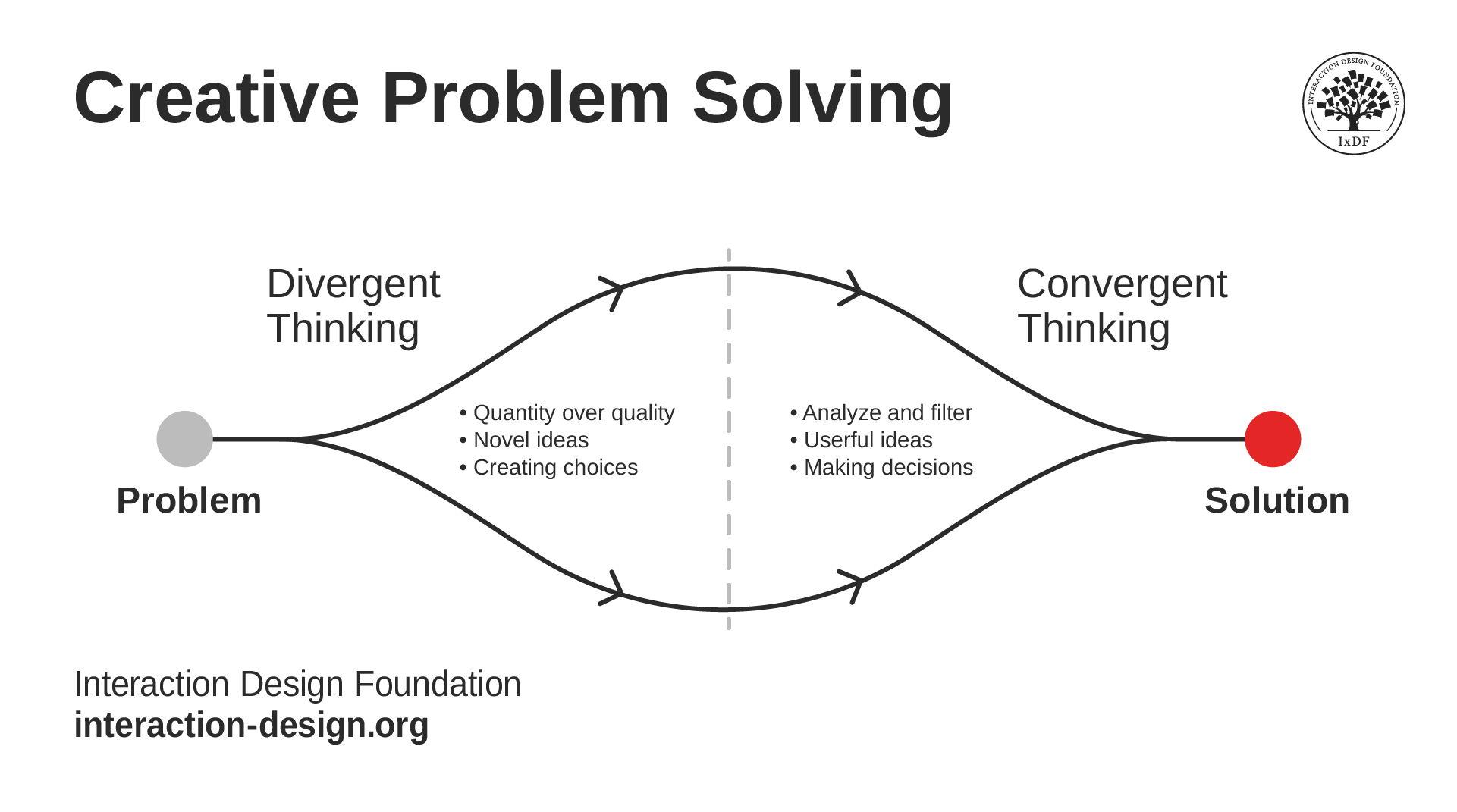
If the creative realm is like an ocean, you’ll want to cast a “net” out as far and wide as possible so you can catch a massive number of ideas. That’s where divergent thinking enters the scene, followed by convergent thinking (where you examine what you’ve found and decide which ideas are worth pursuing).
In this video, Alan Dix explains how creativity depends on both divergent thinking to generate many ideas and convergent thinking to refine them into potentially useful solutions.
ShowHide
video transcript
Transcript loading…
Run divergent ideation sessions: Create mind maps, sketch wildly, brainstorm bad ideas and even the “worst possible idea” sessions (which, despite the name, can trigger great ideas), or do 30 ideas in 10 minutes. Let quantity come first.
Use techniques like SCAMPER (Substitute, Combine, Adapt, Modify, Put to other use, Eliminate, Reverse) to generate fresh angles and access wonderfully “strange” new standpoints that might prompt “Eureka!” ideas.
After divergent thinking, cluster ideas and pick the ones that balance novelty and feasibility: use convergent thinking to fine-tune your way to what might work best.
3. Prototype Early and Often
Prototyping offers essential insights into what might work with the first physical concepts you create to “realize” a design idea.
Turn your ideas into low-fidelity artifacts (such as sketches and paper prototypes) as fast as possible. Education is the name of the game, and the faster you find out what’s promising and what’s not (in the test phase, next), you’ll be able to isolate key areas to develop or, at least, return to the drawing board for more ideas.
4. Test with Real Users; Be Ready to Pivot
Now you have a prototype, you’ll want to see how users find it, feel about it, and if they can use it to achieve goals; the earlier in the design process, the better. So:
Use prototypes to test rough interactions, flows, or micro-interactions; you can learn a great deal from paper and card, and test users can do much with those. You want both qualitative and quantitative feedback before moving on to invest in a high-fidelity prototype.
You can employ this free, easy-to-use template to decide which visualization method, such as sketching or high-fidelity prototyping, is ideal for the stage you’re at in your design process or the audience it’s for.
Observe what users do, not just what they say: People often filter their words and cover up confusion, either out of politeness or fear of seeming “stupid.” So, keep a sharp watch on them as they test your prototype.
Ask open questions: “What would you expect to happen here? Why?” This surfaces assumptions you may not know you held.
Use feedback to discard, revise, or combine directions. Don’t feel tied to any direction just because you liked it; stay open.
5. Refine, Iterate, or Start Over with Something New
You’ve tested your prototype; how did it go? Take that user feedback, analyze it, and plug accurate findings into your redesign. Maybe just the UI needs tweaking. Or perhaps users have surfaced a more fundamental problem in how you approached a potential solution for them. Whether you’re on the right track or must go back for a fresh approach, take it as positive news. It’s far better to discover design problems early on than design in blissful ignorance, release a product, and learn the hard way: in the marketplace.
Common Creative Thinking Pitfalls and How to Avoid Them
Here are typical ones and how to sidestep them.
Jumping to Solutions too Early
If you sketch or think in concrete before you understand the full dimensions of a problem, you risk solving the wrong problem. Delay ideation until you’ve clarified users’ real needs through solid user research.
Self-Editing too Soon
Remember, divergent thinking is a no-judgment zone; don’t label ideas “bad” or “impractical.” Only assess them later, in convergence.
Copying under the Guise of Inspiration
When you scan design pattern libraries or other designers’ work, you might unconsciously replicate. To avoid fixation, blur or abstract inspirations, and then reinterpret them.
Confining Creativity within Safe Zones
Stakeholders may push for safe, familiar, “proven” design patterns, and stifle your creativity. So, try to negotiate a “creative runway” and allocate time or space for wild ideas before formalizing.
Overengineering Interactions
A fancy interaction isn’t inherently better; many genius design ideas prove themselves through their pure simplicity. Let usability and performance guide whether your design idea adds value.
Treating Creative Thinking as Optional
If you leave innovation as a postscript, you’ll reduce it to decoration. Make creative bursts a built-in phase.
Getting Creative in the Wrong Time and Place
Creative thinking shines when aproblem is ambiguous or poorly defined andyou need differentiation or a fresh direction. However, you may need to downplay or pivot from creativity withinhighly regulated domains (like with medical dashboards) where:
Consistency and compliance dominate.
You need to deliver a technically critical fix under tight deadlines.
The core flow requires reliability over novelty.
Remember to envision the wide spread for ideas in divergence and then narrow down for good ones in convergence, and apply the approach to help zero in on what might work best, once you know what the problem is.
Overall, thinking creatively in UX design and UI design can lead you to compellingly fresh ideas and approaches that fly above interface novelties. For example, consider a health and fitness-tracking app using micro-interactions like animated icons and playful transitions so that tracking habits feel like “progress toward a blossoming garden” and you can witness your garden grow.
Remember the “ocean” of creative thought and possibility. You’re free to explore in all directions; so, dive, traverse, plot an open course for “destinations unknown,” and find your way towards building user experiences that feel vibrant and surprising, yet intuitive. As you trailblaze beyond the frontiers of “established” thought and design, far from indulging whims and disconnecting from reality, you can view every project as an opportunity. It’s your chance to push beyond predictable design and create products that both improve people’s lives and help you build a career, and life, you love.
How is creative thinking different from problem-solving in design?
Creative thinking and problem-solving often overlap in design, but they serve different purposes and take different “forms.” Creative thinking opens up possibilities, and designers use it to explore new ideas, question norms, and imagine solutions that haven’t been tried. It involves divergent thinking, where you generate many different ideas without immediate judgment. By contrast, problem-solving is about narrowing down those ideas to choose and refine the most practical, effective solution. It’s more in line with convergent thinking: focusing, testing, and iterating to meet user needs within constraints.
For example, creative thinking might inspire a new interaction model for a mobile app, while problem-solving ensures it aligns with technical limitations and user behaviors.
Consider another area, creative problem solving, as a process to give yourself an edge in exploring design possibilities.
How can I boost my creative thinking as a UX or UI designer?
To boost creative thinking, step away from screens and into different perspectives. Read outside of design; sketch daily; break routine, and you’ll find these habits might help your brain form new connections, which fuels original thinking. Practicing lateral thinking also boosts creativity; try Edward de Bono’s “random word” technique to spark unexpected ideas, for instance.
Another thing: creativity thrives on exposure, so use inspiration from architecture, nature, or photography, not just other UI (user interface) portfolios. This broad input prevents design echo chambers and helps you reach beyond. Moreover, apply constraints intentionally, since (paradoxically) limits can stimulate innovation by forcing you to find clever workarounds.
Leverage lateral thinking to lift your levels of creativity higher.
How do I apply creative thinking during user research?
Creative thinking in user research means looking beyond obvious data and stretching to find what users do not say or realize. When users describe problems, ask “why” multiple times to uncover deeper needs and get behind true causes. This mindset turns surface-level insights into powerful design opportunities.
Use visual synthesis methods like affinity mapping or journey maps to flesh out your research. These tools help reframe fragmented feedback into patterns. Explore unexpected user types or edge cases, too, since they often reveal gaps mainstream users miss.
Explore why and how user research proves essential to any design process.
How can I use creativity when defining user problems?
Creativity plays a key role when framing user problems, since you don’t just accept users’ stated issues but have to dig deeper. Reframe the problem in multiple ways to uncover better starting points for design. This approach mirrors how Google’s design teams generate multiple problem statements before jumping to solutions.
Use “How Might We” questions to unlock different problem angles. For example, instead of “Users struggle with sign-up,” ask “How might we make sign-up feel rewarding?” These reframes invite creative solutions. It’s wise to rewrite every design problem in at least three formats: emotional, functional, and behavioral.
Harness the power of How Might We (HMW) to help throw open the doors on inspiration and many-angled views of the realities facing users and more.
How do I stay creative when working with strict UX guidelines?
Strict UX guidelines can feel limiting, but they often inspire smarter creativity. Think of constraints as boundaries that guide imagination rather than get in the way of it. When everything can’t change, creative thinking focuses on what can.
Try micro-innovation: small, delightful touches within the rules. For instance, you can craft unique empty states or micro-interactions that stay on-brand but enhance experience.
Study design guidelines thoroughly: the better you know them, the easier it becomes to bend them without breaking any and come up with truly novel and impressive results. Smart designers constantly balance brand rules with originality.
Dig into design guidelines and start to consider the many points where you might be able to bend the rules for the better.
What methods help me brainstorm UX ideas more creatively?
To begin, separate idea generation from evaluation, as it frees your brain to think boldly. Use mind mapping to expand a core challenge in all directions.Sketch your thoughts instead of writing; they trigger different parts of the brain and often spark unique angles.
SCAMPER (Substitute, Combine, Adapt, Modify, Put to another use, Eliminate, Reverse) works well in UX brainstorming; it forces you to transform existing solutions rather than start from scratch.
Also, try role-storming: imagine how a child, a robot, or an expert would solve the problem. This shift unlocks lateral ideas from fresh angles.
Scan SCAMPER to see how it might serve to unlock a wealth of insights you can tap towards a smart new digital product or other design solution.
What helps me create original and effective UI layouts?
To design original yet functional UI (user interface) layouts, start with user intent; let the goal shape your layout, not trends. Grid systems keep structure solid while allowing variation in rhythm, spacing, and hierarchy. Break the grid subtly to add visual interest without losing clarity.
Card sorting and tree testing help validate navigation logic, which impacts layout. Moreover, “steal” like a designer andstudy unrelated interfaces such as dashboards and car displays for layout inspiration.
For a creative tip: Create layout variations using the same content. Force yourself to redesign it in five distinct ways to push creative boundaries.
Understand UI design in depth to help make the creative “soil” you grow ideas from more fertile.
How do I use color, typography, and visuals creatively?
Use color and type to guide attention, not just decorate.Color can signal state changes, indicate hierarchy, and influence mood, although for accessibility it shouldn’t be the only way to signal information. For example, warm tones often energize, while cool tones calm. Typography sets tone; serif (with the tiny tails) feels formal, sans-serif feels modern, while weight and scale direct the eye.
Creativity happens in contrast. Use unexpected color pairings or font combinations within accessibility limits, as long as they “work.” Incorporate subtle animations, illustrations, or iconography to bring delight. Try limiting yourself to two typefaces and one primary color, as this constraint forces you to explore visual depth in scale, weight, and placement.
Explore why designers and brands make accessibility and accessible design a “must” for users in the marketplace and beyond, in this video.
ShowHide
video transcript
Transcript loading…
What’s the balance between creativity and usability in UI design?
Creative UIs (user interfaces) must still be usable. If users get lost or confused, creativity fails its purpose. Balance comes from understanding user goals deeply.Then, design imaginative interfaces that still guide behavior effectively.
It’s wise to use Jakob’s Law: users expect systems to work like others they’ve used (from usability expert, Jakob Nielsen). You can innovate visually or interaction-wise, but don’t do both at once. When breaking patterns, include hints or scaffolding to help users adapt.
Remember to test prototypes and designs early. If three users can’t navigate your interface easily, rein it in until it clicks.
Discover important aspects of usability so you can cover that vital aspect of design as well as the creative side.
How can I encourage creative thinking in a design team?
Foster psychological safety first. Team members won’t share wild ideas if they fear criticism; a natural apprehension when you consider ideation can pull in some wild notions. So, create a culture where every voice counts. Start brainstorms with “bad idea” rounds to lower pressure and spark laughter. And, on a serious note, the “bad ideas” method itself makes a powerful approach to ideation.
Diverse perspectives fuel creativity, so mix roles, experience levels, or even departments. Rotate facilitation to let different minds lead and be heard. Encourage rapid sketching or idea sprints to move beyond verbal bias.
Remember the quieter folks and use asynchronous idea boards to allow introverts to shine too. Not everyone thrives in live sessions. Overall, celebrate experimentation over perfection. Share “failed” ideas that led to surprising wins; the irony can pay sweet dividends.
Intrigued by the “bad ideas” approach and want to see how it can reframe things so you can locate otherwise-hidden paths towards successful designs? Get ready for a wealth of fascinating insights and tips in this video with Alan Dix:
ShowHide
video transcript
Transcript loading…
How do I manage creative conflicts with developers or stakeholders?
Approach conflict as collaboration, not combat.Align on shared goals; they’re usually user experience and business value. Speak the other party’s language. For developers, emphasize feasibility. For business stakeholders, highlight return on investment (ROI) or engagement.
Frame your creative choices as evidence-based, and use research, testing, or industry examples. Offer options rather than defending one idea, as this turns the conversation from "yes or no" to "which one?"
If you find yourself in tense moments, ask, “What concern are we solving here?” It can reset the discussion around shared intent.
How do I overcome creative blocks in UX or UI work?
Creative blocks happen when ideas feel forced or pressure builds; and they’re natural occurrences. Step away to reset your mind; take a walk, sketch for fun, or tackle a non-design task. Shifting context often unlocks flow, and it may surprise you.
Change your input to refresh your output. Do some study in a different field like industrial design or behavioral psychology. Use constraints as creative fuel, too. Try “design this with only lines” or “no words allowed” to rewire your thinking.
It’s also wise to keep a design journal. Doodle, list ideas, or log patterns; it can become a go-to when inspiration runs low. Try these tips and your next ideation session might bear more fruit.
What design workshop methods promote team creativity?
Design workshops spark creativity by shifting from passive discussion to active making. Try Crazy 8s to push volume and variety of ideas fast. Use How Might We questions to reframe challenges and spark unexpected paths.
Lightning Decision Jams help prioritize without endless debate. Dot voting allows quiet team members to influence outcomes. Meanwhile, storyboarding and role-playing can help build empathy and turn abstract ideas into real-world flows.
It’s wise to open workshops with an unrelated creative activity, which not only breaks the ice but can shift mindsets and boost idea flow.
Discover how storyboarding can help you explore valuable areas of the idea space in pursuit of the best solution possible.
What are some recent or highly cited articles about creative thinking in UX/UI design?
Khan, A., Shokrizadeh, A., & Cheng, J. (2025). Beyond automation: How UI/UX designers perceive AI as a creative partner in the divergent thinking stages. arXiv.
This research explores how professional UI/UX designers perceive AI tools during the divergent thinking phase of the design process. Through qualitative interviews, the authors reveal that designers view AI as a valuable creative partner when it helps generate alternative concepts, broaden ideation, and ease cognitive load. The study highlights how designers maintain creative control while integrating AI into early design exploration. It provides a grounded perspective on balancing human creativity and computational support, making it an important reference for those studying or practicing design collaboration with AI.
Shokrizadeh, A., Tadjuidje, B. B., Kumar, S., Kamble, S., & Cheng, J. (2025). Dancing with chains: Ideating under constraints with UIDEC in UI/UX design. arXiv preprint arXiv:2501.18748.
This study investigates how various design constraints, such as brand identity, established design conventions, and industry-specific guidelines, affect ideation practices among UI/UX designers. Based on qualitative interviews, the authors identify three distinct designer personas that reflect different attitudes toward constraints. These insights informed the creation of UIDEC, a generative AI-based tool designed to support ideation by producing example designs aligned with specified project constraints. The tool aims to reduce the effort required for prompting while encouraging idea generation. User feedback suggests that UIDEC complements existing design workflows and serves as a helpful source of inspiration, particularly during the early stages of UI/UX projects. The study contributes to the growing body of research on AI-assisted design by offering implications for developing constraint-aware creativity support tools.
What are some popular and respected books about creative thinking?
Kelley, T., & Kelley, D. (2013). Creative Confidence: Unleashing The Creative Potential Within Us All. Crown Business.
In Creative Confidence, Tom and David Kelley, who have both played key leadership roles at the design firm IDEO, explore the idea that creativity is not limited to a select group of individuals. Instead, they propose that creative ability exists within everyone and can be developed through practice and the right mindset. Drawing on their professional experiences, the authors share practical methods and case studies intended to help individuals and teams enhance their creative capabilities. The book highlights the value of creativity in solving problems and fostering personal and professional development, encouraging readers to engage with challenges more openly and resourcefully.
de Bono, E. (1970). Lateral Thinking: A Textbook of Creativity. Penguin Books. De Bono’s seminal work introduces “lateral thinking,” a method for breaking free of linear, logical thought to generate novel ideas. de Bono offers techniques such as random stimulation, provocation, and movement to shift mental patterns. He argues that creativity isn’t spontaneous but can be taught and practiced. For UX/UI designers, Lateral Thinking remains a foundational text: it provides mental tools to move beyond “obvious” solutions and explore breakthrough alternatives. This book laid the groundwork for many modern ideation practices and is widely cited across design, management, and creative fields.
de Bono, E. (1985). Six Thinking Hats: An Essential Approach to Business Management. Little, Brown & Company.
In Six Thinking Hats, de Bono presents a framework to structure group thinking by having participants “wear” metaphorical hats representing modes of thought (facts, feelings, creativity, negatives, positives, process). The method encourages parallel thinking and reduces conflict by focusing on one type of thinking at a time. In design contexts, it helps teams ideate, critique, and decide more effectively. The book has become a classic tool in facilitation, decision-making, and design workshops because it encourages discipline in creative conversation and better alignment across perspectives.
Earn a Gift, Answer a Short Quiz!
Question 1
Question 2
Question 3
Get Your Gift
Try Again! IxDF Cheers For You!
0 out of 3 questions answered correctly
Remember, the more you learn about design, the more you make yourself valuable.
It's Easy to Fast-Track Your Career with the World's Best Experts
Master complex skills effortlessly with proven best practices and toolkits directly from the world's top design experts. Meet your experts for this course:
Alan Dix: Author of the bestselling book “Human-Computer Interaction” and Director of the Computational Foundry at Swansea University.
Don Norman: Father of User Experience (UX) Design, author of the legendary book “The Design of Everyday Things,” and co-founder of the Nielsen Norman Group.
All open-source articles on Creative Thinking in UX/UI Design
Creativity is a massive appeal factor for designers (and those who enjoy what we do!) as they bring to bear their creati
727 shares
8 mths ago
Open Access—Link to us!
We believe in Open Access and the democratization of knowledge. Unfortunately, world-class educational materials such as this page are normally hidden behind paywalls or in expensive textbooks.